MetaHuman Integration Toolkit for Unity
A working Unity 6 research prototype for reconstructing MetaHuman DCC exports and evaluating their DNA rigs through OpenRigLogic. Phase 2 established the facial and body runtime, animation inputs, portable fallback, cross-engine validation, Windows and Meta Quest execution, and a hands-on XR capability demo. Pending Phase 3 work will turn that technical foundation into a production-quality URP character pipeline.
WORKING RESEARCH PROTOTYPE · PHASE 2 COMPLETE · PHASE 3 PENDING · NOT RELEASED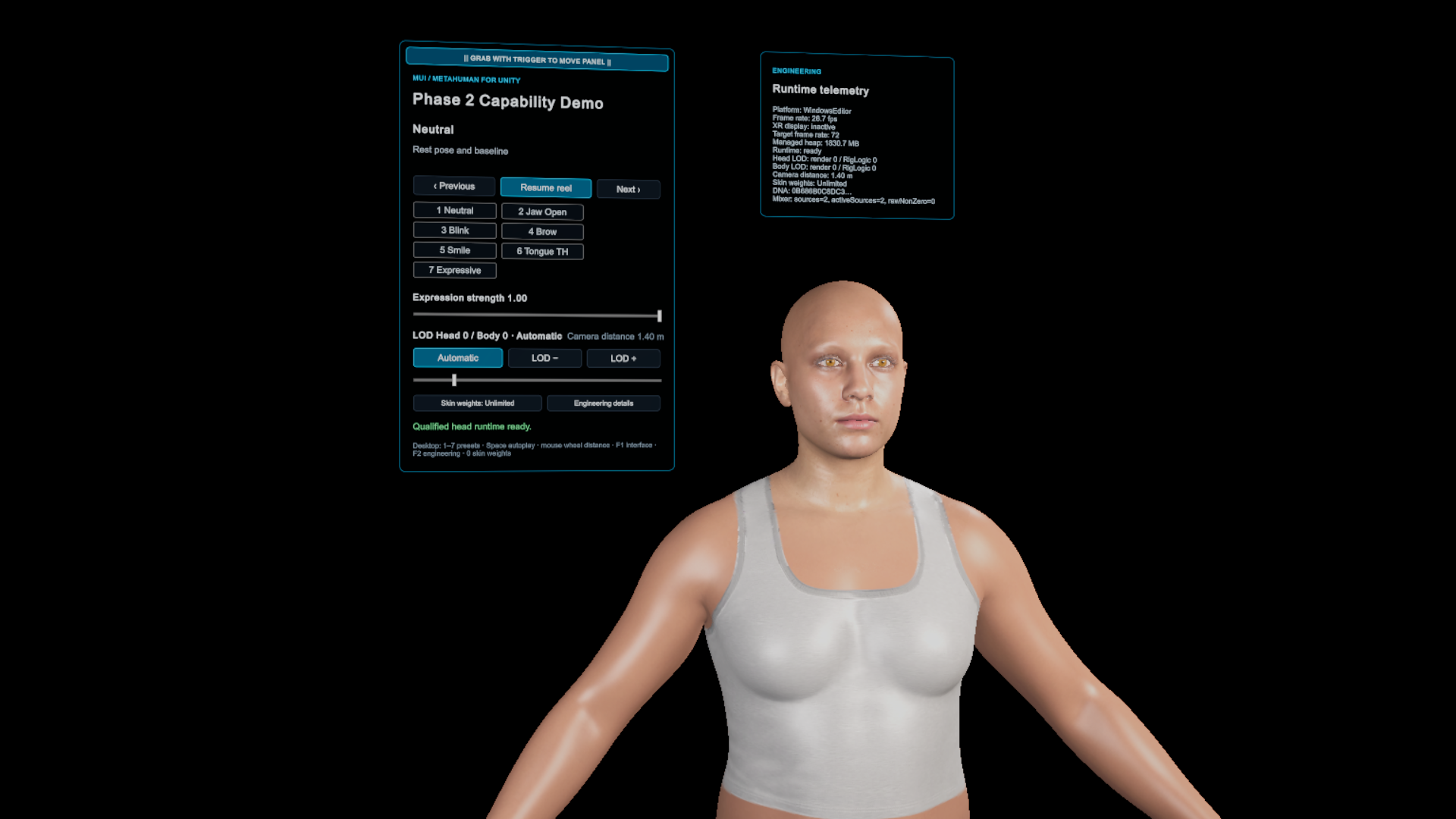
A qualified runtime foundation
MetaHuman Integration Toolkit for Unity discovers and validates qualified DCC Exports, reconstructs head and body assets, and generates Unity meshes, skeletons, skin weights, blendshapes, textures, LOD groups, reports, and a combined character prefab.
Phase 2 completed the native facial and body runtime, deterministic animation-input architecture, portable no-native fallback, two-character cross-engine qualification, Windows and Meta Quest execution, controlled performance sweeps, and separate desktop and immersive capability-demo scenes.
This is a substantial research milestone, not a release claim. Production materials, eye and oral presentation, transparent accessories, groom and hair intake, formal quality profiles, and rendering optimization remain Phase 3 work.
What works now
DCC Export discovery, preflight, import, validation, repair, stable-path re-import, and generated head/body character assets.
OpenRigLogic on Windows x86-64 and Android ARM64 using adapter 5.8.11 and RigLogic 13.2.7, including packaged-DNA loading on Quest.
One deterministic mixer for ARKit validation, Azure visemes, authored AnimationClip curves, Timeline control, and multi-source blending.
Body animation executes before body RigLogic correctives, with authored facial animation synchronized through the same runtime contract.
Named animated-map values drive per-character material properties, with explicit 8-to-4 head/body LOD synchronization.
Ordinary Unity LOD0 meshes, blendshapes, clips, prefab, and manifest run without an OpenRigLogic runtime dependency.
Read-only inventories and compatibility reporting for descriptors, joints, controls, meshes, LODs, blendshapes, animated maps, RBF, ML, and twist/swing data.
Native Unity UI Toolkit controls, desktop and immersive scenes, tracked-controller rays, expression presets, LOD controls, distance testing, and telemetry.
A hands-on engineering surface
The Phase 2 demo makes the runtime inspectable rather than hiding it behind a beauty render. It provides expression controls, synchronized head/body LOD selection, camera-distance testing, skin-weight and engineering views, runtime telemetry, and an XR world-space panel that can be repositioned with tracked controllers.
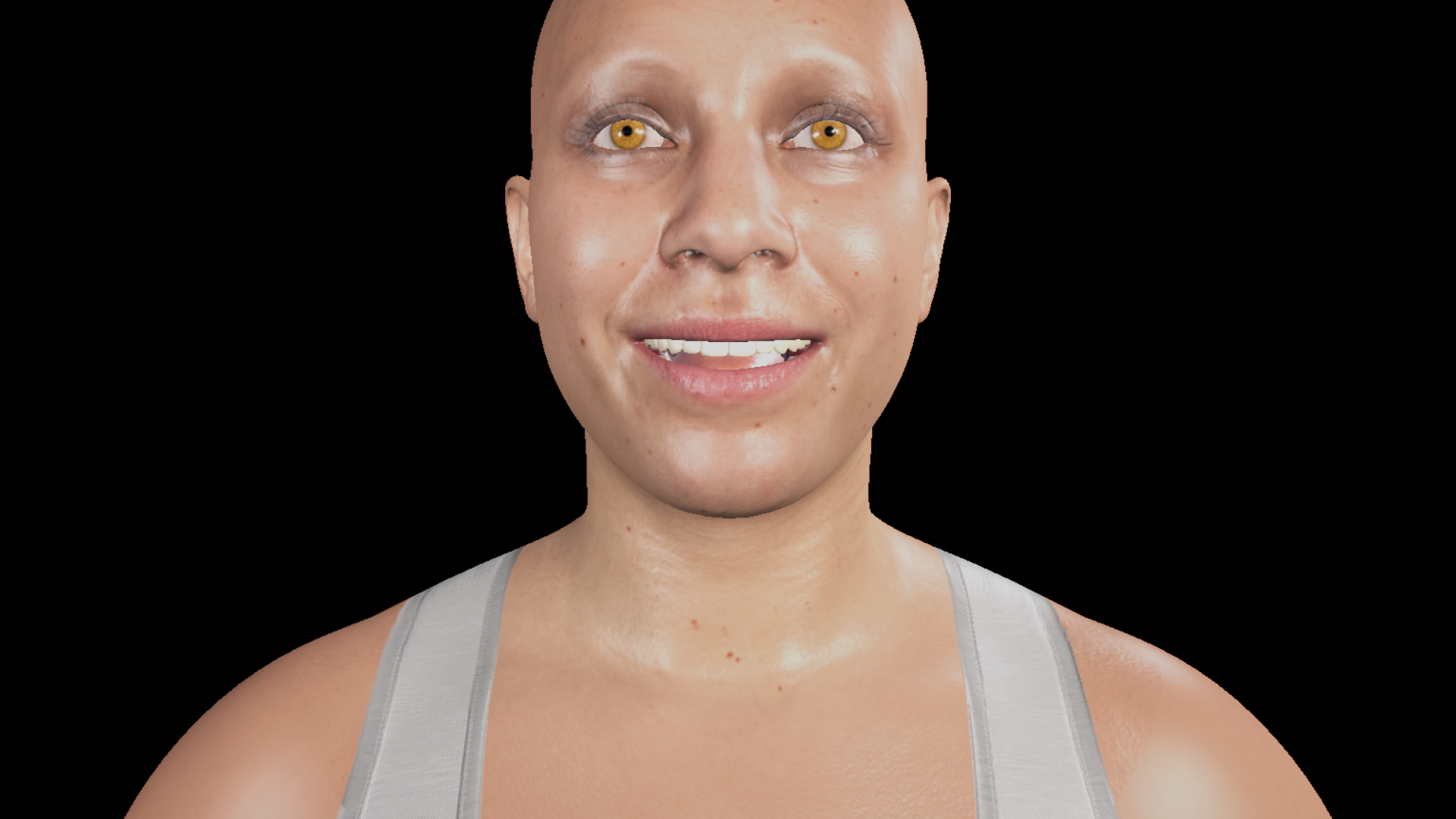
The demo uses the current preview presentation. It does not represent the final Phase 3 skin, eye, oral, lash, accessory, or hair pipeline.
Accepted deformation evidence across two characters
The Capture 5.7 evidence covers neutral, jaw open, blink, brow, smile, teeth/tongue, and body correctives for two distinct MetaHuman fixtures. The accepted gate addresses joint placement, component arrangement, body correctives, and posed-mesh deformation—not identical final materials or complete Unreal visual parity.
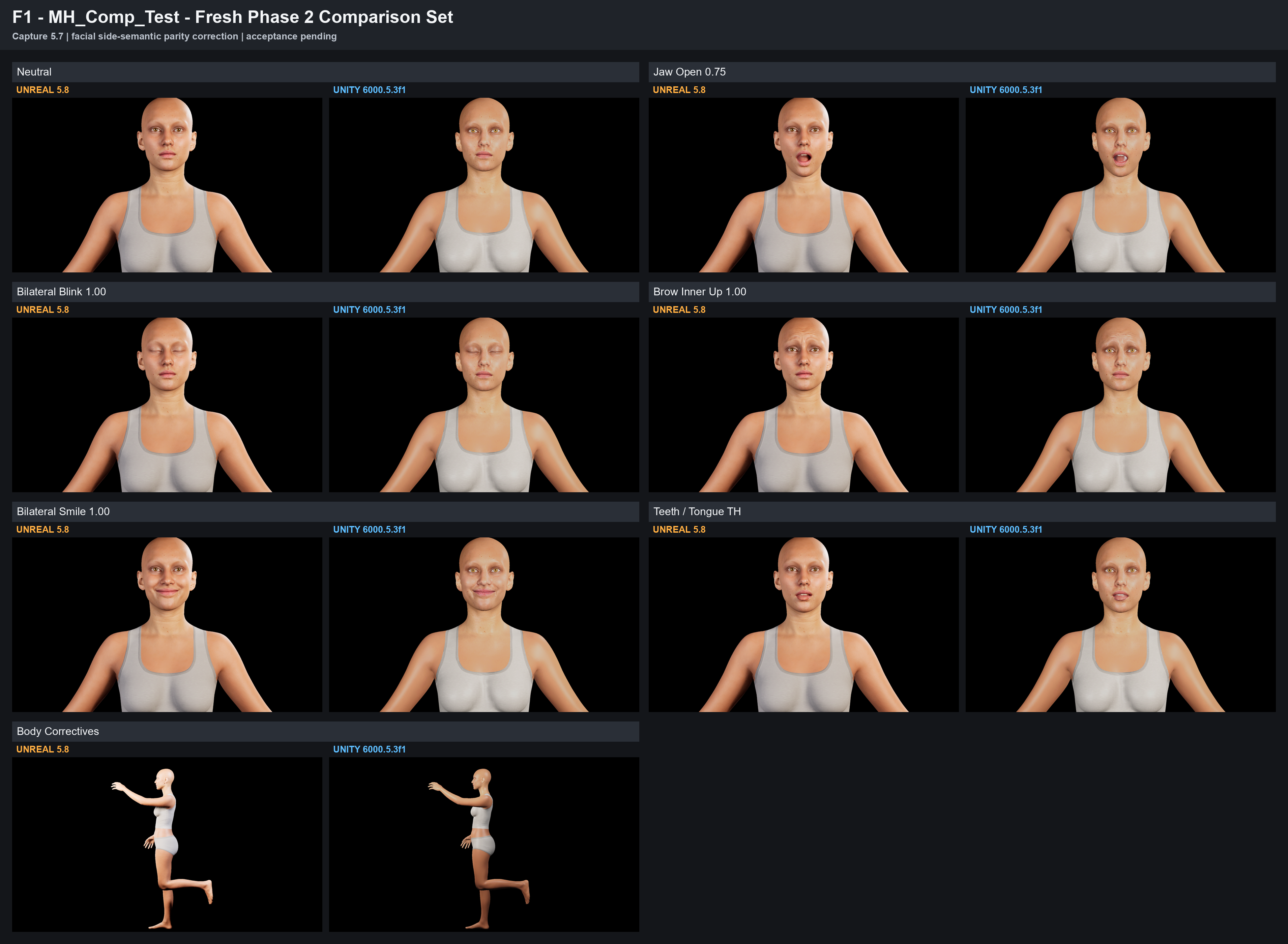
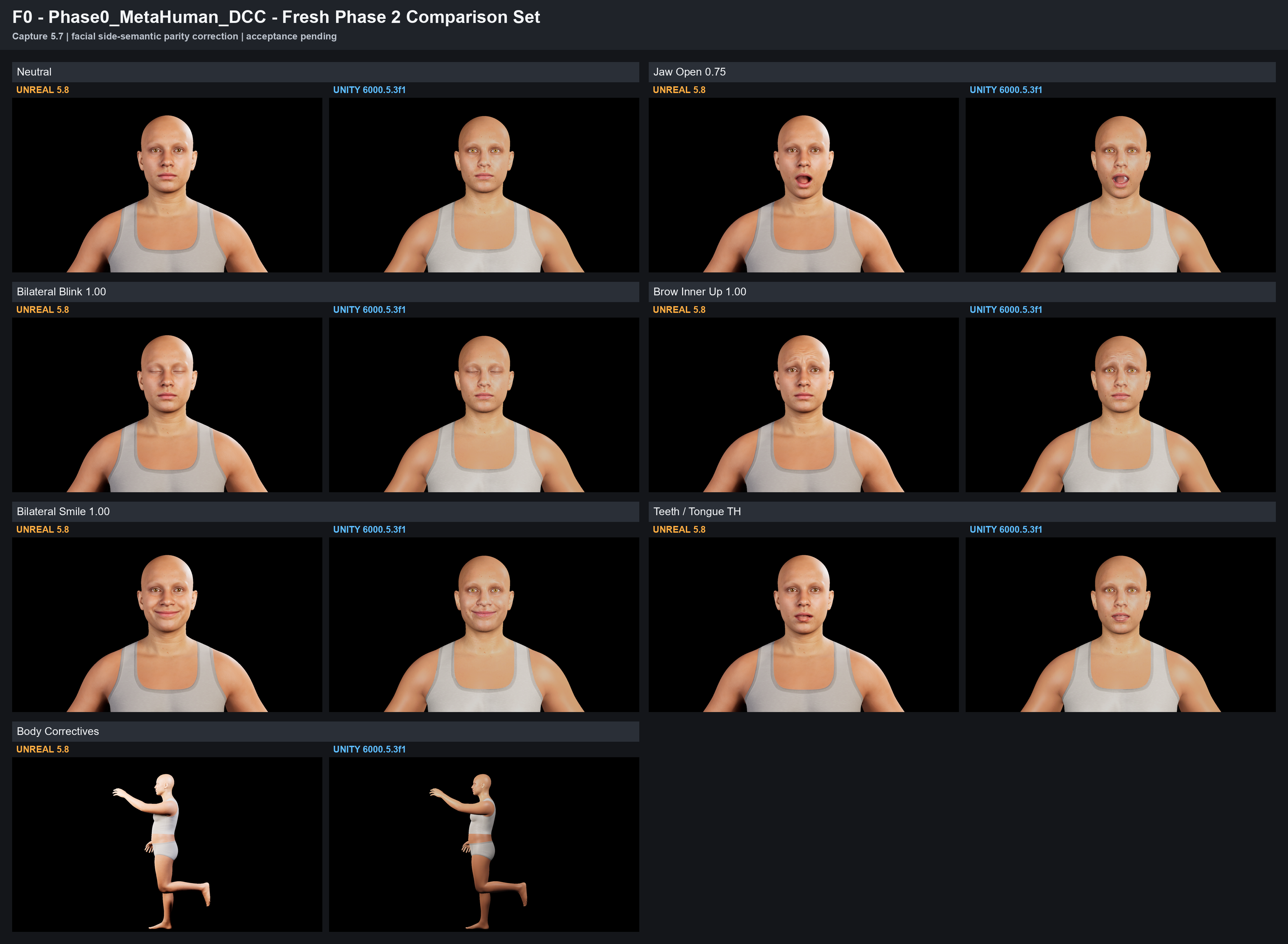
The collages retain their generation-time “acceptance pending” subtitle; acceptance was recorded after pose-by-pose review. Material response, eye refraction and accessories, oral shading, and production lighting remain separate Phase 3 concerns.
Windows and Meta Quest 3, with measured limits
Tier A is validated on Windows x86-64 and Android ARM64/Meta Quest 3. The Quest experience runs natively with packaged DNA, but the current fully rendered profile does not sustain the 72 Hz production target.
63.77 FPS at LOD0 on the qualified Quest 3 profile.
Approximately 30–32 FPS.
Approximately 16–17 FPS.
Disabling character rendering reached 72 FPS; disabling animated maps or shadows did not materially recover the target. Rendering and skinning optimization remain Phase 3 work.
Two deliberately bounded runtime profiles
SOURCE INPUTS → ONE INPUT MIXER → ONE RIGLOGIC EVALUATION → JOINTS + BLENDSHAPES + ANIMATED MAPS → UNITY CHARACTER
Qualified on Windows x86-64 and Quest/Android ARM64 with protected rig lifetimes, UTF-8 and C-ABI hardening, versioned native binaries, packaged-DNA loading, and shutdown cleanup.
APPROVED POSES → EVALUATED TIER A GEOMETRY → UNITY BLENDSHAPES + CLIPS → PORTABLE LOD0 PREFAB
Persisted fixed samples reproduce Tier A vertex positions within approximately 0.01 mm, without an OpenRigLogic runtime dependency.
Tier B intentionally omits live animated maps, the facial skeleton, lower head LODs, arbitrary controls, and native nonlinear pose combinations. It is a measured fallback, not a Tier A equivalent.
The visible product layer
The next phase focuses on deterministic material translation, live wrinkle and skin response, complete eyes and oral surfaces, reliable lashes and transparent accessories, separately sourced groom and hair intake, explicit desktop and mobile/XR quality profiles, and rendering performance.
Production URP skin, eyes, lacrimal, lashes, oral and saliva surfaces; separately sourced groom/hair workflows; quality profiles; and platform-aware rendering optimization.
Batch conversion, CI/headless operation, native build automation, compatibility matrices, re-import policy, multi-character qualification, and packaging.
DNA Diff, UE6/DNA migration, broad FBX fallback, WebGL, Humanoid retargeting, and platforms beyond the qualified matrix are not promised capabilities.
MetaHuman Integration Toolkit for Unity is a working research prototype and is not yet generally available or presented as production-ready. Windows and Meta Quest 3 are qualified development platforms; this does not imply support for every MetaHuman, Unity version, Android device, mobile platform, or XR target.
The current DCC Export does not contain hair or clothing. Groom and clothing intake are separate pipeline inputs. The current preview materials and demonstrated Quest performance envelope remain explicit Phase 3 boundaries.
MetaHuman, RigLogic, OpenRigLogic, and the DNA format are Epic Games technologies. This is an independent integration project and is not affiliated with or endorsed by Epic Games or Unity Technologies.
Epic states that MetaHumans may be used with any engine or creative software under the applicable Unreal Engine licensing terms. OpenRigLogic contains RigLogic and DNA libraries released under the MIT License as part of the MetaHuman Devkit.